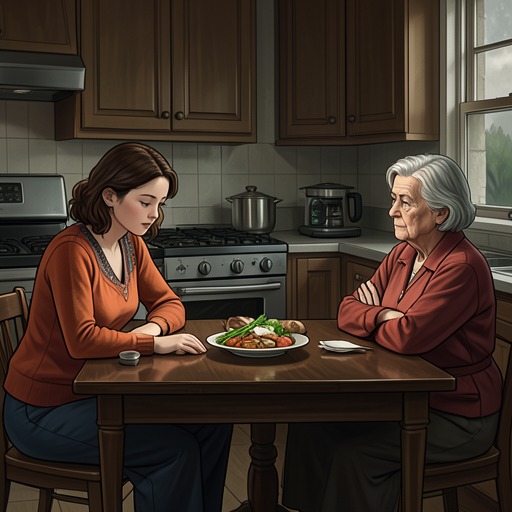
Mo Duvall-Wenstein and Saffron Wenstein
How to Flirt with A Naked WerewolfMo Duvall-Wenstein and Saffron Wenstein are mother and daughter whose intense affection becomes a struggle over where parental care ends and an adult daughter’s independence begins. Saffron’s attention is constant, practical, and often loving in intention, but it repeatedly overrides Mo’s choices; Mo leaves Mississippi to find room to become her own person, then has to defend that boundary directly. Their relationship is neither a simple rejection nor a settled reconciliation: Mo loves her mother, resents her intrusion, and continues to feel the pull of guilt even as she insists on distance.
Family Background and Early Affection
Saffron was born Lynn Duvall in Brownsville, Texas. She met George Wenstein at a recycling seminar in Chicago in 1975, and the two remained together thereafter. They did not marry in the conventional sense; their closest equivalent was a naming ceremony at which Saffron rechristened George as Ash Wenstein. The names in the family carry the same unconventional spirit as its customs: years later, Mo found it apt that her father had named her mother Saffron, after a spice that clings to the skin.
Ash Wenstein and Saffron Wenstein raised Mo according to strong convictions. Religion, television, junk food, Western medicine, and pets were all excluded from their preferred household, though the prohibition on pets reflected Ash’s allergy rather than an animal-rights principle. Their ideals could make family life restrictive, but Mo’s memories also hold genuine warmth. Her parents brought her along on adventures, including Ash’s decision to paint the family van Easter-egg purple and Saffron’s appearance at a nuclear-energy protest dressed as a radioactive Statue of Liberty. Mo remembers their love, generosity, and attention with real fondness, especially the feeling of being the center of their world.
Care That Crosses into Control
As Mo grew older, Saffron’s involvement did not recede with her daughter’s adulthood. When Mo enrolled at the University of Mississippi, Saffron used a security pass to enter her dormitory and later her off-campus apartment building, describing her visits as an opportunity to help. That help took the form of sorting through Mo’s possessions and disposing of food and household products Saffron considered unhealthy or environmentally harmful. After Saffron threw out a bulk-sized box of Hostess Sno Balls, Mo began keeping junk food in a locking plastic tub; Saffron responded by taking the tub to a recycling center.
The conflict was difficult for Mo to frame as straightforward hostility because Saffron believed she was acting in her daughter’s best interests. After discarding Mo’s food, Saffron replenished the kitchen with foods Mo had enjoyed as a child, including nine-grain bread, tofu dogs, and carob cookies. That mixture of care and disregard left Mo feeling that even anger was hard to claim: her mother was protecting her health, in Saffron’s own understanding, while treating Mo’s preferences and possessions as things she could manage. Arguments, Mo felt, were slippery; whenever she seemed to pin down the issue, Saffron changed tactics.
Mo’s desire for distance grew alongside her efforts to establish an adult life. She worked toward a marketing degree and dreamed of moving to Illinois, New York, or California, far from Mississippi. What she wanted was not merely a different job or a new address, but solitude, privacy, and a home her parents could not enter with a spare key obtained from her maintenance man. Her parents’ presence had become so normal that independence required more than asking them to knock.
Independence, Departure, and the First Boundary
The dispute came into sharp focus around Mo’s graduation. She confronted her parents over what she experienced as their lack of interest in an achievement that mattered to her, while they had long taken an active role in other parts of her life. She resented their disapproval of her choices and their belief that her teachers had brainwashed her. The conflict exposed a painful imbalance: her parents could be intensely involved in her day-to-day affairs yet fail, in Mo’s view, to support the future she had chosen.
Afterward, Saffron resumed her pattern of frequent visits, bringing marinated tofu, herbal teas, and keepsakes from Mo’s childhood. The intrusion intensified after Mo became engaged to Tim Galloway, an insurance adjuster whose office was next to hers. Saffron treated the couple’s morning lattes at Starbucks as evidence that the relationship was doomed, because she distrusted the coffee chain and what it represented. Her criticism of Mo’s relationship thus extended the same pattern seen in the kitchen: concern became a reason to judge choices that belonged to her daughter.
At twenty-nine, Mo recognized that she had spent years pursuing independence while still letting her parents shape her decisions. She worried that rebellion itself had become a way of organizing her life, and that her unhappiness might not be explained solely by her parents. Starting over promised a test of who she was away from them, but the prospect also frightened her. She ultimately packed up while her parents were away at a civil-rights conference. The departure spared her the tearful confrontation she had dreaded, but it left her with guilt and irritation; she could acknowledge that the method was drastic without reversing the decision. Saffron’s own advice that Mo should be more unpredictable added an unwitting irony to the escape.
The Call from Grundy
Once Mo had settled in Grundy, calls from her mother remained a recurring pressure. During the drive, Mo’s cell phone rang for the twenty-seventh time that day. She ignored it, anticipating that her first evening in town would involve deleting Saffron’s unheard voice mails, as the previous evenings had. The repeated calls made distance a practical matter as well as an emotional one: Mo could leave Mississippi, but Saffron could still reach her by phone.
Mo eventually called home after learning that Saffron had a general search area. Before dialing, she prepared herself with Tums, yoga, and a chocolate chess square, and hoped Ash might answer because she expected him to be less capable of lecturing or inducing guilt. Saffron immediately demanded to know how Mo could have run away and moved in the middle of the night without telling her. She framed the departure as rejection, asking what her parents had done to make Mo hate them and insisting that they had only loved her too much.
Mo answered by naming the difference between love and respect for privacy. She recalled Saffron going through her kitchen and throwing out food, contacting Mo’s boss about attending Burning Man, and trying to obtain the results of Mo’s annual gynecological exam from the doctor’s receptionist. Saffron defended herself as a concerned parent who did not intend to obtain information she was not supposed to have. For Mo, the lack of malicious intent did not resolve the problem: Saffron did not take seriously boundaries that mattered to her daughter.
The argument also reached into Mo’s romantic life. She objected to Saffron’s lack of embarrassment about sitting on the foot of the bed while a naked Mo and Tim were there and promoting tantric sex. She explained that dating Mo could feel like dating her whole family, an added burden when she was already trying to find someone who accepted her flaws. But she made clear that Tim was not the reason she had left. She needed to find out who she was apart from her parents and to have space to breathe.
Contact on Mo’s Terms
Saffron disputed Mo’s account of parental influence, pointing to Mo’s use of plastic grocery bags as evidence that she had always made her own choices. She also relayed Ash’s view that parents who claimed the right to make their own choices had to respect their daughter’s, even when those choices ran against what they had taught her. The exchange leaves the family’s conflict more complicated than a clean break: Saffron resists Mo’s interpretation, but Ash’s stated position recognizes the principle Mo is trying to establish.
When Saffron asked for Mo’s new address and phone number so the family could reach her in an emergency, Mo refused to give her home number. She knew the phone beside her bed would otherwise ring morning, noon, and night, while a cell phone could be switched off or allowed to go to voicemail. Choosing which contact information to share gave her one boundary she could still control. She offered to call when she could and allowed Saffron to email her instead. Saffron pleaded and raised the possibility that Ash might have another episode; Mo ended the call while holding back tears. She felt guilty, but did not believe that wanting a life on her own terms was wrong.
Saffron later sent a large package to the Grundy post office, addressed to the postmaster because she did not have Mo’s street address. The name on the label was Mo’s full name, Moonflower Freedom Refreshing Breeze Joplin Duvall-Wenstein, which made the recipient identifiable as the only Wenstein in town. The package shows that Saffron continued to seek contact, but did so without the direct access Mo had refused to provide.
Inside were a long letter Mo did not read, books advocating against meat and fast food, a vegan cookbook, and an elaborate album of family photographs. The images gathered scenes from Mo’s childhood: a body artist painting her face when she was four, a concert with her father when she was six, and a protest with her mother outside the Mississippi Supreme Court when she was nine. Mo could no longer tell what that childhood protest had been about. Alongside the books and photographs, Saffron packed sugar-free honey-oat cookies, wheat germ, and digestive-health biscuits and supplements with a pamphlet. She spent one hundred dollars on shipping. The contents combine a mother’s effort to send familiar comforts and memories with the same prescriptive concern about Mo’s diet that had helped drive her away.
An Unresolved Bond
The relationship’s defining contradiction persists across these encounters: Saffron’s attachment is real, but so is the pressure Mo experiences when affection becomes surveillance, advice, or access without permission. Mo’s memories of a generous and exciting childhood prevent her from reducing her mother to an antagonist; her adult recollections of discarded food, unwanted interventions, and calls prevent her from treating love as sufficient justification. Distance allows Mo to choose when and how contact happens, rather than ending the bond altogether.
The available episodes do not show a final reconciliation or a complete severing of contact. Instead, they establish an ongoing negotiation in which Mo protects her independence and Saffron continues to reach toward her through calls, arguments, and a carefully assembled package. The contrast between the unread letter and the photographs Mo does inspect captures the divided nature of their connection: Mo declines one direct appeal while still confronting the shared past her mother has sent. Their relationship is therefore a continuing emotional tie, but one Mo can sustain only by insisting that closeness cannot mean unrestricted entry into her home, choices, or private life.